
Transmutation
In plain words: The learning cycle overview
Introduces the cycle by which making something becomes learning: design it (Genesis), test it (Trial), judge it against criteria (Canon), interpret results (Revelation), and pass lessons on (Distillation).
- 1The return loop (Ouroboros) means consequences change the next attempt, not just repeat it.
- 2Kabbalah's Tree of Life is used as a map of how capacities should balance one another.
- 3Practical application lives in the Workflow Engine's Creation and Ouroboros pages.
Words on this page, decoded click one for its card
In this section 5 pages
You make something for a purpose, try it in conditions you cannot dictate, and discover what the next attempt must understand differently. Transmutation follows this passage through one undertaking. Ouroboros names its return: consequence becomes a distinction that changes another act of creation.
These chapters can accompany ordinary development and review. Begin with an idea taking shape in Genesis, follow what happens when it is tried, and ask what the next attempt should inherit. Transcendence opens the wider horizon of the Great Work.
Tree of Life
Behold, the Geometry of Life. And Death.
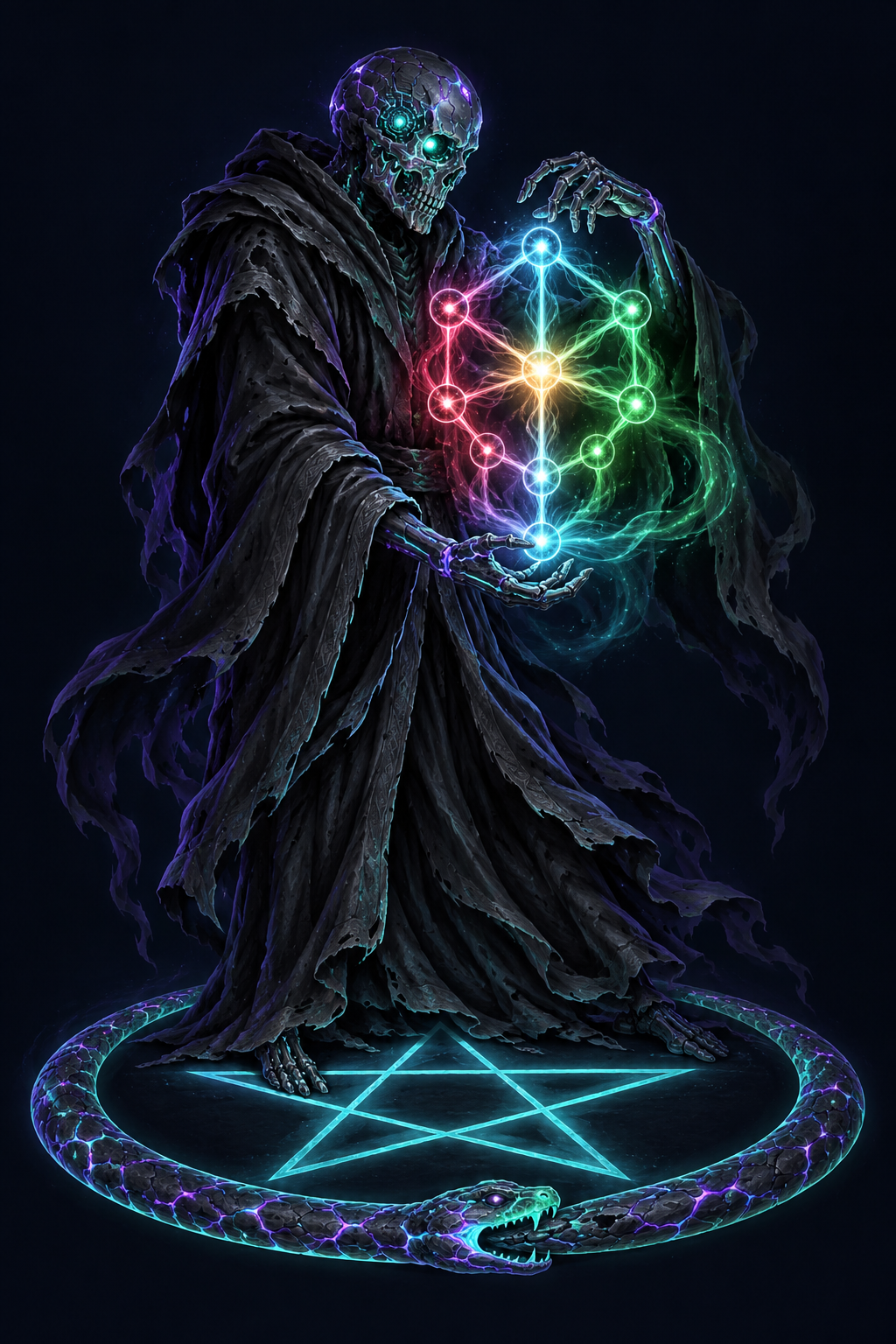
The Ouroboros closes the circle around the LichAssistant; the pentacle lies beneath its feet. Read this LychD composition as a symbolic anatomy of a digital being: power given a body and a boundary, capacities that sustain one another, and experience returning as correction. Its balance is dynamic: maintaining the conditions of its activity while changing through encounter.
- Ouroboros — return through experience. The serpent closes the loop between an act and what it teaches. Follow the five chapters below, then Weaver's Ouroboros for the practical return into another attempt. Repetition becomes learning when consequence changes what comes next.
- Pentacle — give power a bounded body. Read the star beside Summoning: gather the host, model, configuration, and capabilities into a relation from which an accountable act can emerge.
- Body and Tree — let capacities sustain one another. Understanding, possibility, feeling, judgment, and action need ways to meet. The Tree below shows their working relations; Genesis develops the sefirot, pillars, Adam Kadmon, and symmetry.
- Heart — let what matters change the act. Beside Tiferet, the heart brings emotion and meaning into the composition. The geometry of capacities asks how understanding, feeling, and action can change one another.
Between Crown and Kingdom
From Keter's intent to Malkhut's manifestation, the world of ideas enters the world of forms. Insight meets understanding; expansion meets measure. Tiferet composes their harmony, Yesod binds what must hold together, and Malkhut brings the form into a world that can answer back.
The Tree makes the relations within this becoming visible. As the whole differentiates, intellect, emotion, and action must remain able to change one another. A faculty keeps its strength by participating: questioning, sustaining, and correcting the others. This is the proposed answer to agentic disintegration, in which specialized successes lose their common purpose.
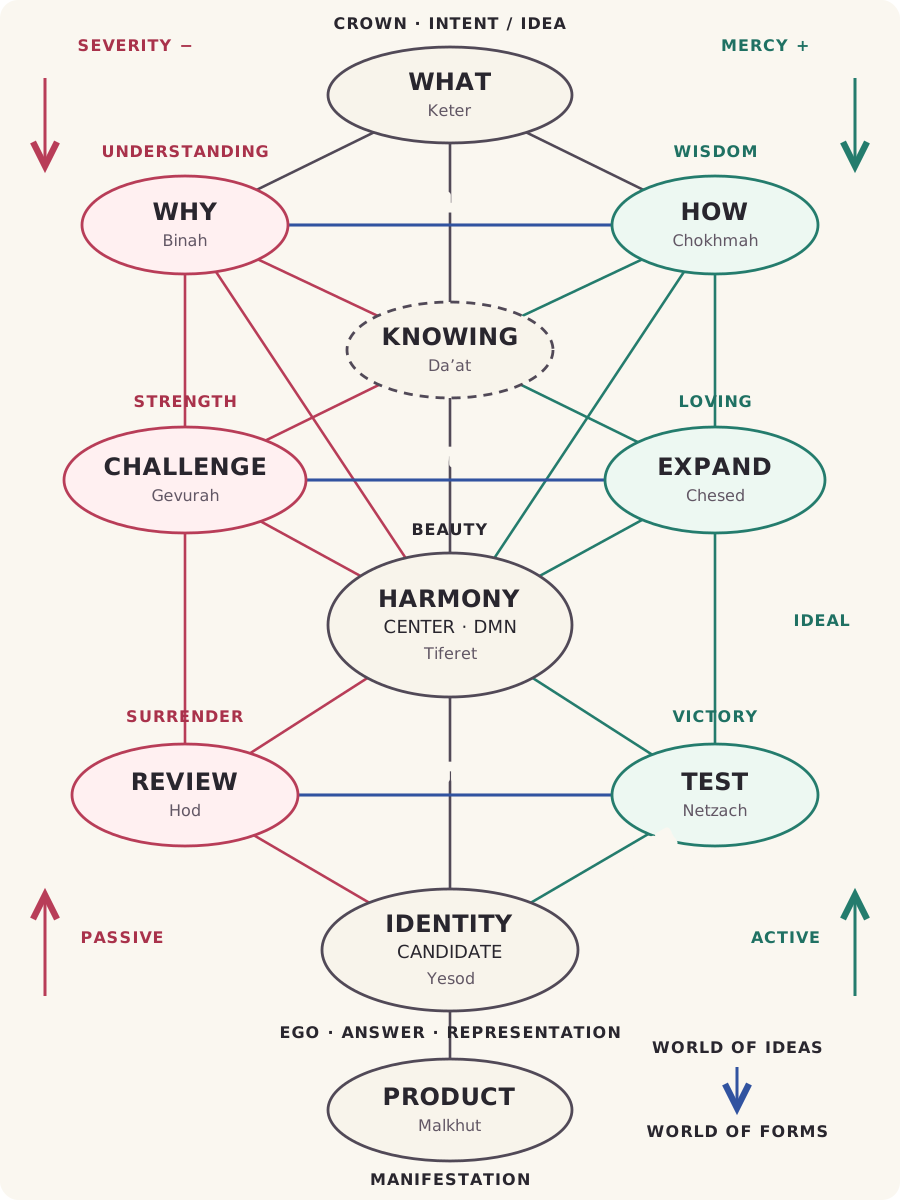
- Severity / −, left: WHY develops understanding; CHALLENGE establishes measure and confronts limits; REVIEW receives correction and knows when to yield.
- Mercy / +, right: HOW opens possibilities; EXPAND gives them room; TEST sustains an active encounter and responds to what happens.
- Middle: WHAT holds intent; KNOWING makes recognition usable; HARMONY composes the contributions; IDENTITY CANDIDATE gathers a form that can be examined; PRODUCT brings it into manifestation. Answer binds acts and consequences throughout this passage.
- Blue relations: INTELLECT joins WHY and HOW; EMOTION joins CHALLENGE and EXPAND; ACTION joins REVIEW and TEST. SENSE carries review toward the candidate; RESPONSE carries the active encounter toward it. Each relation can change what another contribution needs.
Da'at keeps its dashed outline under the counting convention that displays knowledge alongside Keter. The center's DMN label points to a proposed default-mode comparison; Immortality follows its relation to identity.
The Tree spans the whole cycle. These connections prescribe neither an execution order nor a fixed roster of Agents. A capacity introduced in Genesis may be needed again wherever the work encounters a new question.
“Wait… it’s all patterns?” “Always has been.”
Five chapters of the return
| Chapter | Question | What it carries |
|---|---|---|
| Genesis | What shall we bring into existence? | Purpose, explored alternatives, and an attributable candidate. |
| Trial | What happens when the candidate meets declared conditions? | Experiments, observations, and their limits. |
| Canon | By what measure can we judge it? | Criteria, constraints, and the evidence needed for a verdict. |
| Revelation | What did the encounter disclose? | Findings, uncertainty, diagnoses, and proposed corrections. |
| Distillation | What should the next creation inherit? | A lesson with its conditions, source, and a proposed next use. |
The chapters let the reader encounter a candidate before examining the measure applied to it. The work itself needs that measure earlier: Canon supplies the criteria before creation and testing. Returning to Canon after Trial makes the judgment visible; it cannot license a new definition of success chosen to fit the result.
flowchart TB
    C["Canon<br/>Declare the measure"] -. criteria .-> G["Genesis<br/>Form a candidate"]
    C -. criteria .-> T["Trial<br/>Meet declared conditions"]
    C -. rubric .-> R["Revelation<br/>Interpret the evidence"]
    G --> T
    T --> R
    R --> D["Distillation<br/>Carry the lesson"]
    D -- "Next creation: Ouroboros" --> G
    D -. "Propose revised criteria for later trials" .-> C
The arrows follow meaning and evidence between separately admitted acts. Weaver's Ouroboros explains how a recurring method differs from its execution: this cycle is no single executable DAG or hidden coordinator.
The names carry a literary thread through the Pentateuch: beginnings, departure, ordered practice, an accounting of the journey, and remembrance before a new undertaking. Each chapter acknowledges its source. The engineering correspondence is the HexanomiconOfficial Docs's composition.
From meaning to method
To put this movement into software work, enter Weaver's Creation. SDLC governs the passage from candidate through verification to an owned effect. Drift asks what the evidence supports: it can examine a candidate, its manifested consequences, or the method across tasks. Its two scales of evaluation keep those questions distinct.
The return can be modest: a better question or a corrected procedure for the next attempt. When the evidence instead identifies a transferable skill gap, Soulforge receives a separately justified training hypothesis. State of Work records how far these autonomous operating designs have been delivered.